News
HDPE Pipeline Installation Under a River: How It Works
HDPE pipeline installation beneath a watercourse is one of the more demanding things you can ask a piping system to do. There is no trench, no open cut across the riverbed, and no second attempt once the pull begins.
Here is how a crossing works, and what the pipe has to survive to get there.
Why not simply trench across?
Open-cut across a river means diverting or damming the flow, excavating the bed, laying the pipe, and reinstating everything afterwards. It is slow, it is disruptive, and in South Africa it brings environmental authorisation requirements that can add months to a programme before a machine arrives on site.
It also puts the pipeline in the least stable ground available. Riverbeds move. Scour during a flood event can expose a shallow crossing years after it was signed off and accepted.
Drilling beneath the bed is why HDPE pipeline installation solves all three at once. The line sits well below the scour zone, the channel is never touched, and surface works are confined to a compact area on each bank.
The three stages of a crossing
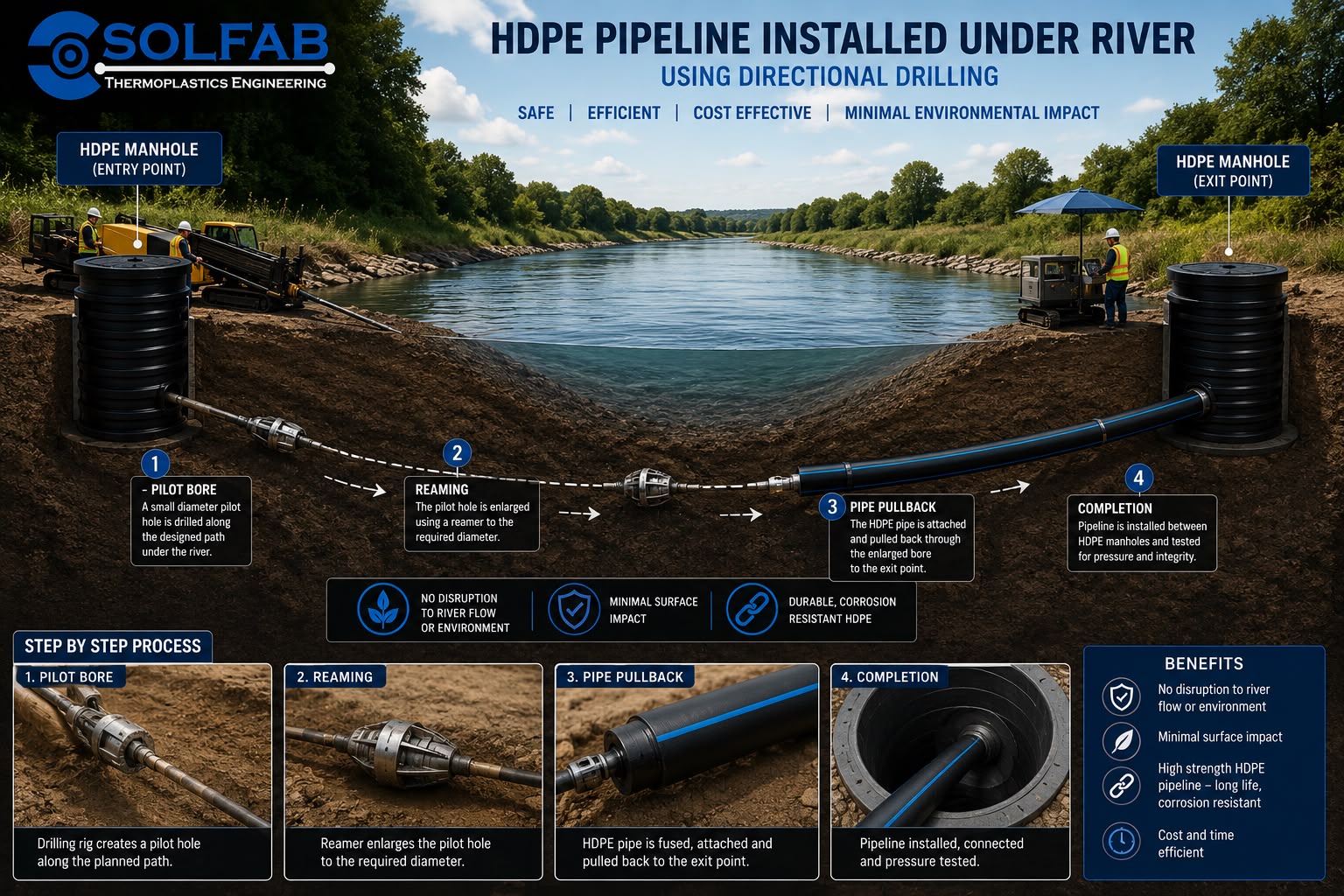
Pilot bore
A drill rig on the entry bank drills a small-diameter bore along a designed path beneath the river. The head is steered and tracked as it advances, so the bore follows the intended profile and surfaces at the planned exit point on the far bank.
Reaming
The pilot bore is far too small for the product pipe. A reamer is drawn back along the path, enlarging the bore to a diameter comfortably larger than the pipe that will follow. Drilling fluid stabilises the bore wall and carries cuttings out as it goes.
Pullback
The pipeline is welded into a single continuous string on the exit-side bank, connected to the drill string, and drawn back through the reamed bore to the entry point.
That third stage is where the choice of pipe stops being a line on a specification and becomes the entire job.
Why HDPE pipeline installation suits a pullback
Throughout the pull, the pipeline is under sustained axial tension for the full length of the crossing. It is being dragged through a bore that is never perfectly straight, against friction, surrounded by drilling fluid.
In HDPE pipeline installation, a jointed alternative has a discrete weak point at every joint, and every one of those joints is loaded during the pull. Failure at any single one means the line is compromised somewhere it cannot be reached.
A butt-fused HDPE line does not have joints in any meaningful sense. Fusion melts the pipe ends and forces them together, producing a bond across the full wall thickness. The result is not a connection between two pipes. It is continuous pipe.
Polyethylene also has the flexibility to follow a curved bore path without fittings, and enough surface toughness to be dragged against a bore wall without gouging through.
Once the line is through and has relaxed, the same properties that got it there keep it serviceable. No joints means no infiltration and no exfiltration. No metal means no corrosion, whatever the groundwater chemistry happens to be.
What happens at each end
A crossing is only useful if it connects to something, and the transition points do a lot of work.
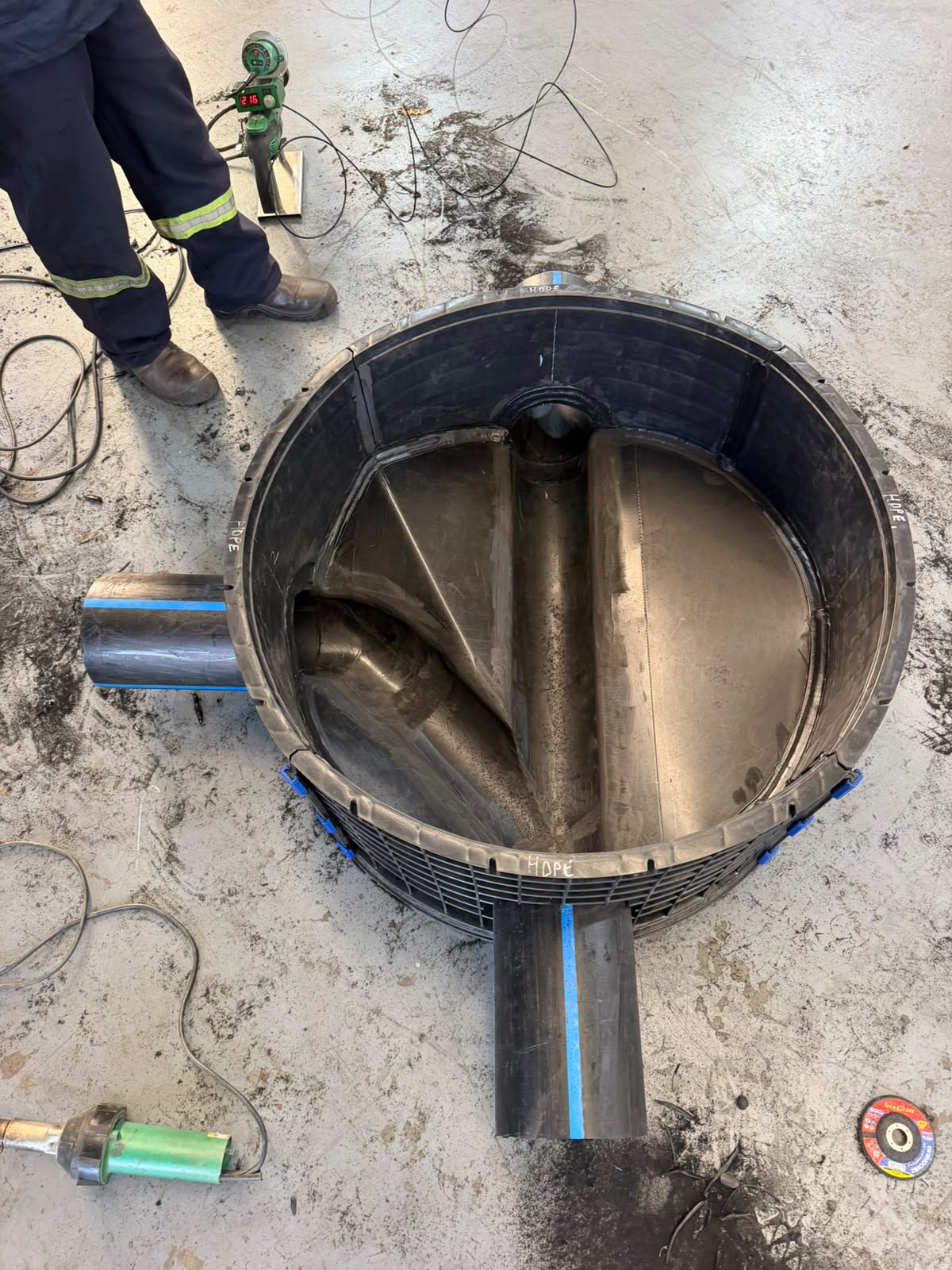
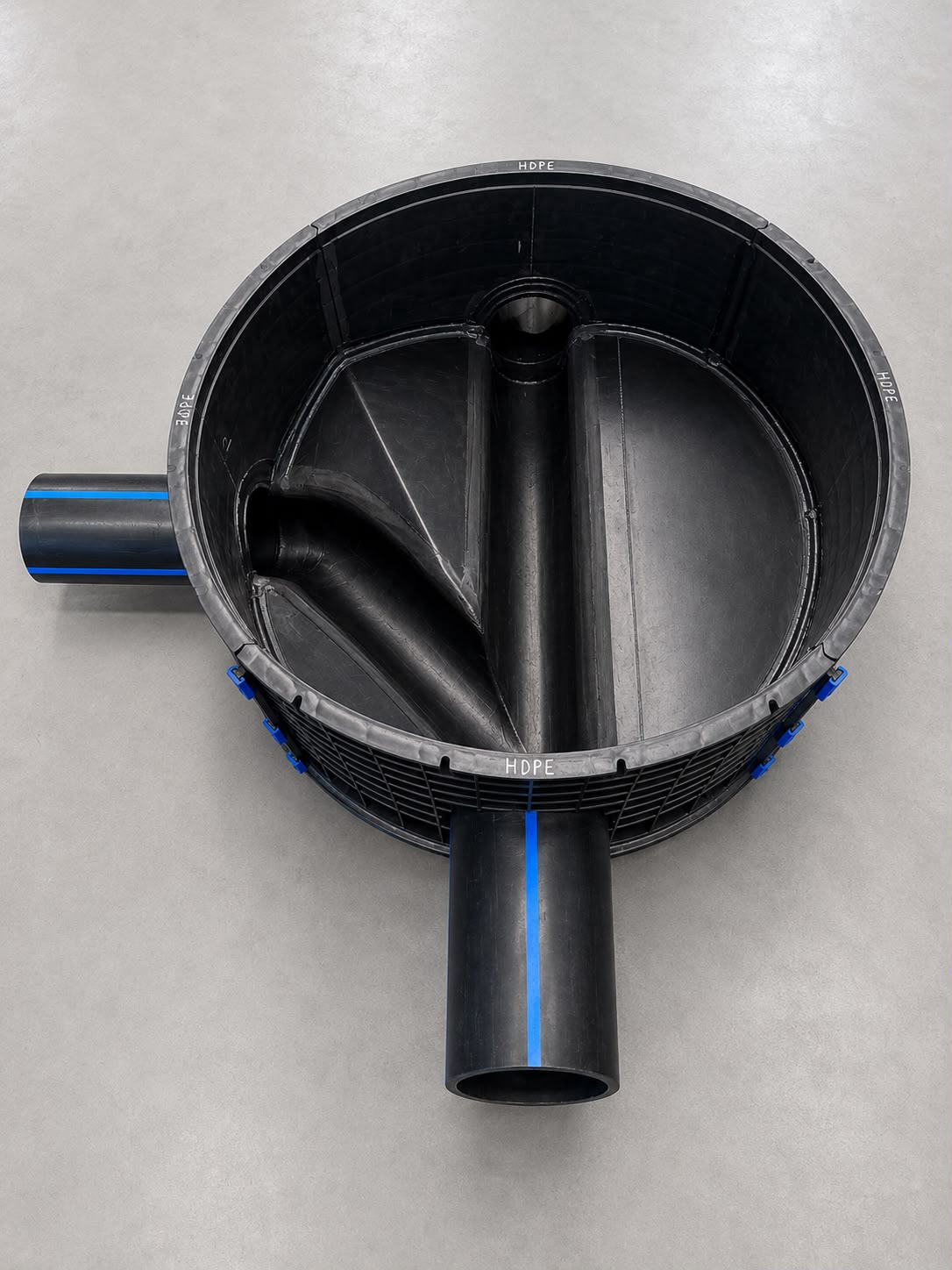
Fabricated HDPE manholes at the entry and exit provide that transition. Building them in HDPE rather than concrete keeps the entire assembly in one material, and the pipeline connects into the chamber by fusion rather than by grouting into a socket. The connection is as sound as the pipeline itself.
Those chambers are built to the job rather than selected from a catalogue. Inverts set to the survey levels. Inlets and outlets positioned and angled to match the lines actually arriving. Benching welded into the base so flow moves cleanly through instead of pooling.
Where else this applies
River crossings are the obvious case, but the method and the reasoning apply to any obstacle you cannot open up. Major roads, railway lines, runways, wetlands, established services corridors, and any site where a surface trench would cost more in disruption than the pipeline is worth.
The requirement is the same in every case: a continuous, jointless, corrosion-resistant line that can be installed in a single pull and then left alone.
Getting the specification right
A crossing is a design exercise before it is a construction one. Bore profile, reamed diameter, pipe wall thickness and calculated pull force all interact, and discovering a specification error partway through a pull is an expensive way to find out.
Solfab supplies solid wall HDPE from 16mm to 3500mm to SANS 4427-2, and structured wall HDPE from 50mm to 3500mm to SANS 21138-2. We fabricate the manholes, carry out the welding, and provide the structural design input and sign-off support that gets a crossing approved.
The Southern African Plastic Pipe Manufacturers Association sets the standards framework this work operates within.
If you have a crossing coming up, send us the drawings and we will come back with a specification and a quote.